
Week -6 brought steady progress as subteams pushed through early-season infrastructure tasks. The focus remained on validating systems, starting prototypes, and ensuring our hardware and software foundations are stable.
Software: Camera Stress Testing and System Updates
Software spent the week testing the limits of our vision hardware and preparing the driver environment.
- The team began by stress‑testing the Orange Pi and MitoCANdria setup, checking how frame rate and target stability changed with multiple cameras and motion in view. This helped establish realistic performance expectations.
- They escalated the test from a few cameras to seven cameras connected simultaneously, discovering that the Orange Pi could not reliably support that load.
- After connecting the Pi to MitoCANdria, only three of seven cameras appeared on the webpage, though all showed up in NetworkTables. This mismatch helped identify bandwidth and processing bottlenecks.
- The team split the load across two boards: three cameras on an Orange Pi 5 Pro and three on an Orange Pi 5 Plus. The 5 Plus rebooted after extended use, likely due to overheating, so a proper case is now on the procurement list.
- Separately, the driver station and pit laptop were updated, ensuring both are ready for early-season testing and consistent with team standards.
These findings give the team a clearer picture of what the vision system can support and what hardware adjustments are needed before integration.
Strategy: Rules Tests and Cycle-Time Modeling
Strategy focused on preparing the team for the game manual and building tools for early decision‑making.
- The group created two rules tests: a general test for the full team and a more detailed version for the drive team, emphasizing penalties and scoring. Both were drafted and shared for review.
- They also produced a cycle‑time goals document, outlining realistic intake and scoring times based on expected gameplay.
- A companion spreadsheet of variables and point values was built, allowing the team to model different scoring paths and compare strategic options quantitatively.
This groundwork ensures the team enters kickoff with a structured way to evaluate robot capabilities and match strategies.
Mechanical: Chassis Adjustments and Hopper/Intake Prototyping
Mechanical made significant progress on both the chassis and early game‑piece handling concepts.
- The frame was raised above the swerve modules, then several other adjustments were made: lowering bumper height to 2.5 inches, cutting the frame from 30 inches down to 27.5 inches, and later refining it to 26 × 26 inches to meet this year’s construction rules.
- The bellypan remains on the to‑do list, but the structure is now sized correctly for the season.
- A major prototyping effort focused on the hopper and intake system. The team tested multiple approaches for moving fuel from intake to shooter, including:
- roller‑only systems
- conveyor belts
- rollers with zip ties for additional agitation
- They evaluated how each method handled different fuel quantities, how reliably the hopper expanded during a match, and how durable each mechanism felt under repeated use.
- A detailed scaled sketch of the hopper concept was created, mapping out roller mounts, conveyor paths, hopper walls, and the intake geometry.
These iterations give the team a clearer sense of what designs are viable and what needs refinement in the next sprint.
Electrical: Power, CAN, and Chassis Integration
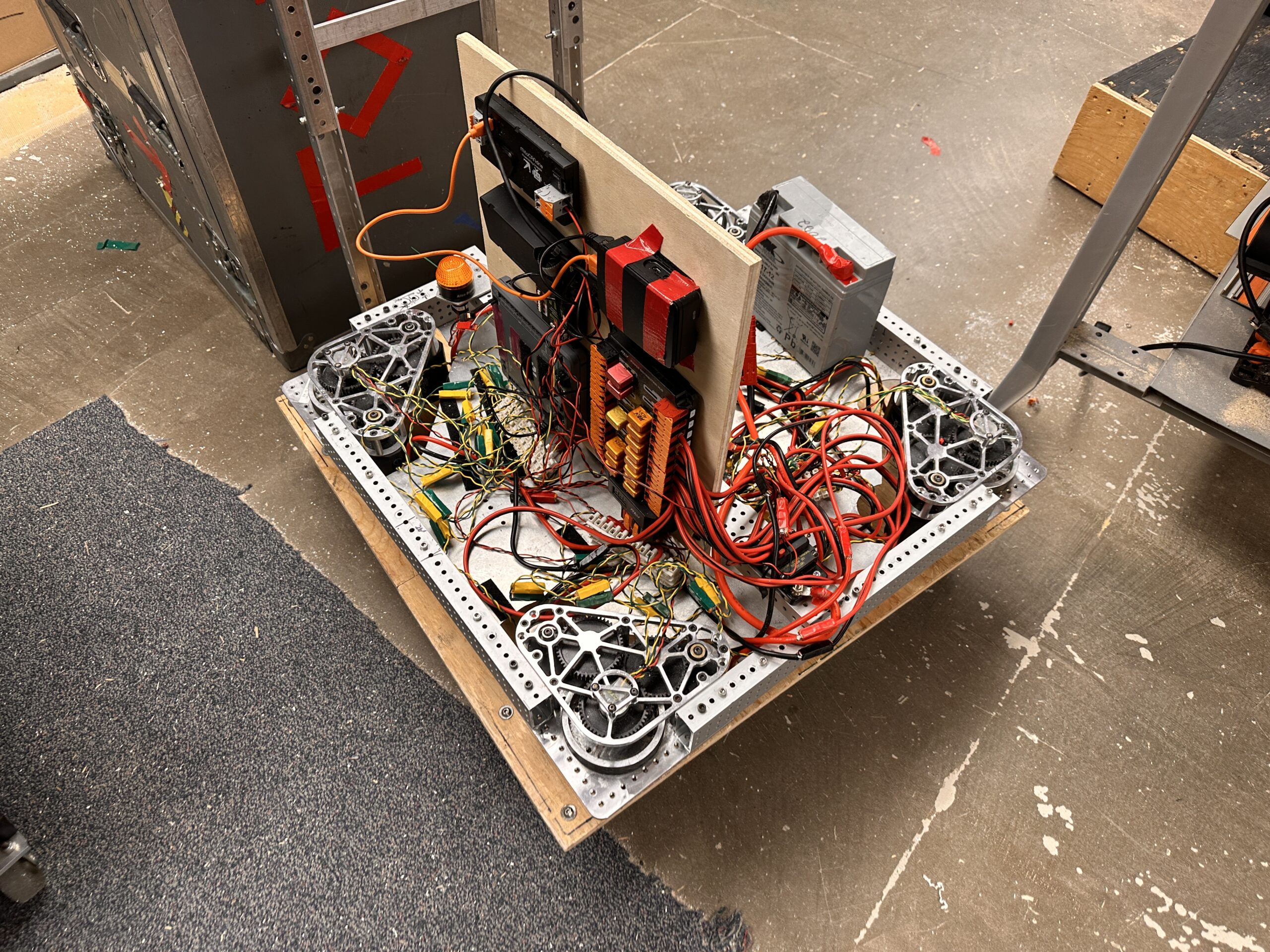
Electrical focused on wiring the RED chassis and preparing it for programming.
- Power distribution was fully connected, and CAN wiring began mid‑week.
- By January 23, CAN wiring was completed, with plans to connect the system to Roadkill for testing.
- The RED chassis was fully assembled and wired, with cameras mounted and ready for software integration.